


Beyond Big Emotions: Helping Children Build a Richer Emotional Vocabulary
Many parents will be familiar with the phrase “big feelings”. It has become part of the everyday language of early childhood, and for good reason. Young children do experience emotions with great force. They need adults who can stay calm, name what is happening, and help them feel safe enough to return to themselves.
But every useful beginning has a next step. A three-year-old may need simple language such as big, small, happy, sad, angry or calm. As children grow, their thinking becomes more layered. They begin to understand that the same object can be a truck, a fire engine and red at the same time. The same growth is possible in emotional life. A child can slowly learn that feelings also have qualities, causes, mixtures and degrees.
At Alto Montessori, we see emotional language as part of development. The goal is not to make children speak like adults. It is to give them the words, experiences and calm boundaries they need to understand themselves with increasing accuracy.
Understanding the Developmental Logic
Simple emotional language is a sensible place to begin. Very young children are still developing the capacity to hold more than one rule, category or perspective in mind at once. When a toddler is overwhelmed, they are not usually ready for a long conversation about disappointment, embarrassment, frustration and fatigue. They need safety first. They need a steady adult, a few clear words, and time for their body to settle.
This is why early emotional language often starts with broad categories. “You are sad.” “That was scary.” “You are having a big feeling.” These words can be useful because they reduce confusion. They give the child a handle for an experience that may feel too large to organise from the inside.
Montessori education has always understood that development moves from the concrete to the abstract. Maria Montessori wrote that education is “a natural process carried out by the child” through experiences in the environment. This matters deeply for emotional learning. Children do not learn emotional understanding through adult explanation alone. They learn it through repeated lived experiences: waiting for a turn, repairing after conflict, noticing another child’s face, completing difficult work, being gently stopped when their body becomes unsafe, and discovering that frustration can be survived.
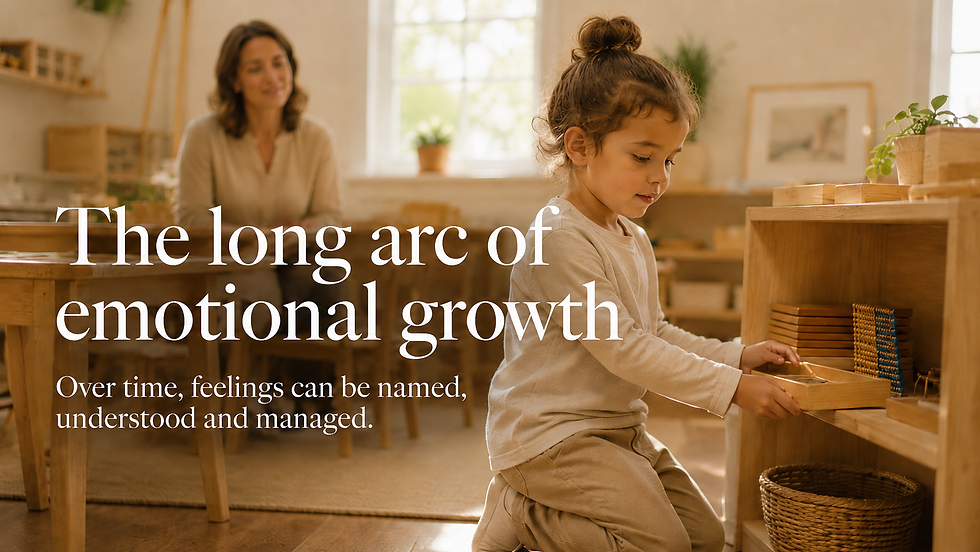
The prepared environment supports this by giving the child real situations in which inner life becomes visible. A child pouring water may feel concentration, pride, irritation, disappointment and relief across the space of a few minutes. A child building the Pink Tower may experience anticipation, effort, error, adjustment and satisfaction. These are emotional experiences, although they do not always look dramatic from the outside. Montessori practice gives children time to stay with these states instead of rushing them immediately towards praise, rescue or distraction.
Modern developmental research points in the same direction. Executive function, including working memory, flexible thinking and self-control, develops gradually through the early years. Around four to five years of age, many children become more able to hold two different rules in mind and shift between them, although this remains effortful. Theory of mind, the understanding that another person can think or know something different from oneself, also strengthens during the preschool years. Later, in the primary years, children become more able to understand mixed emotions, such as feeling excited and nervous together.
For parents, the practical meaning is simple: children need emotional language that grows with them. Early on, broad words help. Over time, only using broad words can leave children with a map that is too simple for the territory they are trying to navigate.
A helpful distinction is the difference between emotional intensity and emotional meaning. “Big” tells us something about intensity. It tells us that the feeling is strong. It does not tell us what the feeling is about, what the child needs, or what might help. A child who is crying at drop-off may be tired, unsure, disappointed that a parent is leaving, worried about a change in routine, or simply needing a familiar sequence to begin the day. All of those can look like a “big feeling”. They are not the same experience.
This is where adult calm becomes part of the teaching. When adults stay regulated, we can be more curious and more accurate. We can move from “this is big” to “I wonder if this is hard because the morning changed” or “you wanted more time with Mum” or “you are disappointed because the bike was already being used”. The adult does not need to get it perfectly right. The value is in showing the child that feelings can be looked at carefully, named respectfully and understood without panic.
This is also why boundaries matter. A child who is upset may still need a firm limit: “I won’t let you hit.” That limit is not a rejection of the feeling. It is part of the structure that helps the child learn that emotion and action are different. They may feel furious. They may not hurt another person. They may feel disappointed. They may not throw the work. They may feel excluded. They may still need to use words, seek help, or wait.
In Montessori terms, this is freedom within limits. Freedom means the child is treated as capable of growth. Limits give that growth a safe shape. When a child is allowed to feel everything but not do everything, they gradually learn the difference between inner experience and outer behaviour. That distinction is one of the foundations of self-regulation.
There is another misconception worth softening. Richer emotional language does not mean asking children to analyse themselves constantly. Too much talking can overwhelm a young child, especially when they are already distressed. The aim is not to turn every moment into a lesson. It is to provide the right word, at the right time, in a concrete situation the child can recognise.
A child who is calm after a conflict may be able to hear, “You were frustrated because the tower fell, and then you were angry when Sam touched the blocks.” A child who is still sobbing may only need, “I’m here. You’re safe. We’ll breathe.” Timing matters. Development before outcome. Understanding before performance.
Practical Application: What This Looks Like in Daily Life
The easiest way to build emotional vocabulary is to use ordinary moments. Parents do not need special charts, scripts or elaborate programmes. Daily family life already provides enough material.
At breakfast, a child may be upset because the blue bowl is unavailable. At one level, this is a small moment. At another level, it is an opportunity to name disappointment, flexibility and waiting. A calm response might be: “You wanted the blue bowl. It is disappointing when the one you want is being used. Today you can choose the green bowl or the white bowl.”
Notice what this does. It names the feeling, gives a reason, and holds the boundary. The adult does not need to persuade the child to be happy about the bowl. The child is allowed to dislike the limit. The limit still stands.
At drop-off, emotional language can be equally simple. “You are sad to say goodbye. You know I come back after rest time. I will give you one cuddle, then Charlotte will help you start your morning.” This gives warmth without turning the separation into a negotiation. It also gives the child a sequence, which is often more helpful than repeated reassurance.
During play, parents can add more precise words when the child is ready. If a child shouts because a sibling changed the game, try: “You were surprised when the game changed. Then you felt cross because you wanted it to stay the same.” If a child refuses to try something difficult, try: “This feels tricky. Sometimes tricky work makes us want to stop. We can take one step.”
These phrases are small, but they build a more detailed map. The child begins to hear that feelings have causes. They shift. They can be strong without being dangerous. They can exist alongside action.
Environmental adjustments matter as much as language. A child who is frequently overwhelmed after childcare may not need more emotional discussion in the car. They may need food, quiet, fewer questions and a predictable rhythm. A child who struggles with transitions may need a visual sequence, a consistent goodbye ritual, or fewer choices when tired. A child who becomes frustrated with dressing may need clothing arranged in order, enough time, and fewer adult corrections.
In Montessori homes and classrooms, the environment does some of the emotional work before the adult speaks. Low shelves, limited choices, child-sized tools, clear routines and a place for each item reduce unnecessary friction. This does not remove all difficulty. It removes confusion that does not serve development. The remaining challenge can then become useful: waiting, trying again, completing a task, asking for help, repairing a mistake.
One practical habit is to add one layer of language at a time. If your child already knows happy, sad and angry, you might begin adding disappointed, worried, frustrated, excited, calm, surprised and proud. Use the words in context rather than as vocabulary drills.
“You look proud. You worked hard on that.”
“That was surprising. You didn’t expect the balloon to pop.”
“You are disappointed. You wanted Grandma to stay longer.”
“You feel frustrated. The zip is stuck.”
“You are excited and your body is moving very fast. We need walking feet inside.”
The last example is especially important. Emotional naming should not replace boundaries. When children are excited, tired or upset, they still need help organising their bodies. The adult can acknowledge the feeling and guide the behaviour in the same breath.
Parents can also model their own emotional vocabulary without making children responsible for adult feelings. “I feel a bit rushed this morning, so I am going to slow my voice down.” “I was frustrated when I dropped the groceries. I’m going to clean it up and try again.” This shows children that adults have feelings too, and that feelings can be managed without blame.
Stories are another gentle tool. After reading, parents can ask concrete questions: “How do you think she felt when her friend left?” “Was he angry, or was he embarrassed?” “Can someone feel happy to go to the party and nervous at the same time?” Keep the conversation short. The purpose is to open a doorway, not test comprehension.
Conflict between children offers some of the richest learning, although it rarely feels that way in the moment. When one child grabs a toy, the adult can slow the situation: “You wanted the truck. Leo was using it. You felt impatient. I won’t let you take it from his hands. You can ask, ‘Can I have it when you’re finished?’”
This sequence teaches several things at once. Wanting is allowed. Taking is stopped. Waiting has language. The other child’s experience is named. The child is given a path forward.
For busy parents, the aim is not to do this beautifully every time. Some days, the best response will be brief: “You’re upset. I hear you. The answer is still no.” That is still useful. Calm consistency teaches more than perfect wording.
Common Parent Concerns
“My child only says they are angry, even when it seems like something else.”
That is common. Children often use the strongest or most familiar word first. You can gently add detail without correcting them sharply. “Yes, you feel angry. I think you might also be disappointed because the game ended.” Over time, the child hears that one feeling word does not have to carry the whole experience.
“Won’t giving more words make my child more emotional?”
Usually, accurate language helps children organise emotion rather than intensify it. The key is timing. During the peak of distress, use fewer words. Afterwards, when the child is calmer, add the extra layer: “You were worried I had gone, and then you felt better when you saw Charlotte.”
“My child is too young for this.”
They may be too young for long explanations. They are not too young to hear respectful, simple naming. For toddlers, one word and one boundary is enough: “Angry. I won’t let you hit.” Preschool children can usually manage a little more: “You’re angry because it was your turn and the timer finished.” The language grows as the child grows.
“What if I name the wrong feeling?”
That will happen. It is not a problem. You can model adjustment: “I thought you were angry, but maybe you were sad that Dad left.” This teaches children that understanding feelings is a process of noticing and refining, not a performance to get right immediately.
“My child uses emotional language to argue with limits.”
This is also normal. A child may say, “You’re making me sad” when you hold a boundary. You can acknowledge the feeling without giving the feeling control of the decision: “You are sad. You really wanted another show. The screen is finished now.” This is a powerful developmental lesson. Feelings are real. Limits can still be kind and firm.
Emotional vocabulary is one of the quiet foundations of self-understanding. Children begin with broad categories because broad categories are developmentally useful. As their thinking grows, their language should grow with it.
Parents do not need to rush this process or turn daily life into constant emotional coaching. The work is much simpler and more ordinary: stay calm where possible, name what is happening with increasing accuracy, hold limits without shame, and give children concrete experiences that help the words make sense.
A child who can say “I’m frustrated because it didn’t work” is already standing in a different place from the child who only knows “I’m bad” or “this is too big”. That difference is built slowly. Consistency matters more than perfection.


Comments